Nikhil Tornok
Systema Delenda EstNikhil Tornok, also known as Grand Paladin Nikhil, is a Bismuth-rank champion of Clan Tornok and a senior adherent of the divine System. His decisive role is to convert a doubtful report from the frontier into an officially sanctioned crusade against Sydea. He first appears as an administrator of hierarchy and privilege, but his investigation gives him access to exceptional divine tools, allowing him to impose the System’s judgment through overwhelming force. His confrontation with Onswa makes the abstract power of the System brutally visible and establishes Nikhil as one of its most direct instruments.
Identity and Position
Nikhil travels through Ikent as the escort of ten young Copper-rank charges connected to Clan Tornok. Although the clan name carries less authority on the frontier than in the core worlds, Nikhil’s position in the middle of Bismuth is sufficient to deter local interference. He understands power as both a social fact and a military resource: Clan Tornok protects its members only as far as its force of arms reaches, while a Bismuth’s personal strength can command respect anywhere.
He is careful not to advertise why the clan has dispatched several important new rankers toward the frontier. The young Coppers are meant to appear ordinary, and Nikhil reprimands Esik when the boy forgets that an Ikent world will respect no strength except the strength an individual can personally demonstrate. The lesson reveals Nikhil’s practical intelligence beneath his aristocratic assumptions. He may expect better conditions because he comes from the core, but he recognizes that frontier authority must be enacted rather than merely inherited.
Nikhil’s rank also places him above the normal administrative order. Bismuth-rank figures rarely accept Planetary Administration positions, which are more suitable for people stalled at Platinum, yet they are understood to be the true rulers. In the cities he passes through, Silvers and Golds retreat from his path without being ordered to do so. His authority is therefore embodied in movement: lower ranks clear the streets before him, while his Coppers follow as a visible train of clan power.
Investigation on Ikent and Uriva
Nikhil’s pilgrimage through Ikent initially appears routine. He stops at the System Nexus to update his map, notices that the capital possesses a six-spired temple, and orders his charges to meditate there. He also enters the temple to seek divine Skills, possible quests, and information that might aid the faith. The temple’s Platinum-rank priest treats him with formal humility, and Nikhil responds as a powerful but attentive patron, giving the priest a Platinum token so that a divine message can be sent without impoverishing him.
At Uriva, the investigation acquires a concrete subject. A local priest introduces him to the young Copper-rank Muar, a Sydean whose testimony concerns extraordinary events on Sydea. Nikhil approaches Muar with open contempt, regarding Sydeans as savage and soon-to-be-extinct people, yet he is willing to listen because Muar has committed himself to the divine System. His prejudice does not prevent investigation; instead, it shapes the standard by which he evaluates the witness.
Muar’s account is difficult to believe, but Nikhil’s Skills confirm that the Copper is not lying. Nikhil still suspects exaggeration, misunderstanding, or the use of Skills at a level beyond Muar’s comprehension. Even so, the report convinces him that Sydea faces something more serious than an ordinary Copper advancement quest. He rewards Muar with Platinum Essence Tokens, D-tier Universal Skill Tokens, and four Silver-tier Equipment Tokens, invoking his Clan Tornok authority to make the payment. The generosity is also a calculation: information about Sydea is valuable, while the recipient’s low rank means that even lavish gifts remain within what a Clan Tornok Copper could be permitted to receive.
Nikhil concludes that the matter is not important enough to summon an Azoth or Alum immediately, but he refuses to treat it casually. His method is characteristic: he does not rush into danger merely because a report is alarming. He intends to prepare first, and his patience becomes the threshold through which the System’s divine intervention arrives.
The Cleansing Quest and Divine Arsenal
While meditating before the System pylon, Nikhil channels his keystone Skill, Divine Conduit. The strange testimony continues to press upon his attention, giving his waiting a ritual quality: he remains at the temple because he believes the gods have a purpose for him, even before he knows what that purpose is. The resulting quest confirms his intuition. The System ordains him to cleanse Sydea, with the quest counting toward the Feats of Glory required for Azoth Rank.
The quest is accompanied by equipment and Skills of extraordinary quality. Nikhil receives the Clasp of Stone and an overloaded S-tier Stone Lance Skill Token. The overloaded Skill bypasses normal Skill restrictions and effectively grants him an additional Skill at his highest rank. Although Stone Lance is not a conventional divine Skill, Nikhil understands why it has been chosen: if Muar is correct that one of Sydea’s moons is compromised, the celestial source of the destructive Skill may need to be attacked directly.
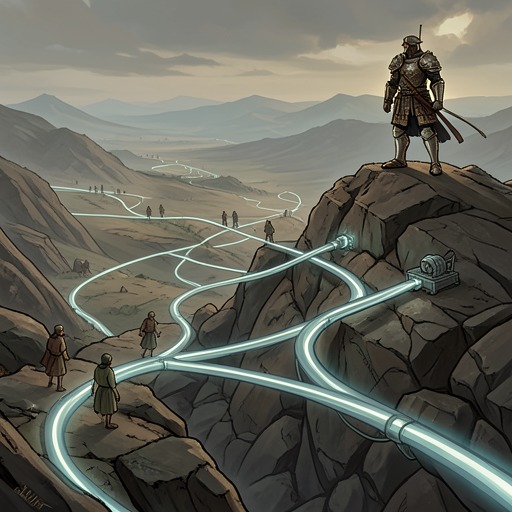
The God’s Eye gives Nikhil vision across arbitrary distances and the means to strike accurately with applicable Skills. The Clasp of Divine Stone reduces the cost of divine and stone-type Skills while amplifying their power. Most specifically, the Scepter of Annihilation is designed to destroy any creation of Cato. It is simultaneously the most powerful and most limited object Nikhil has ever received: its authority is effectively irresistible, but its purpose is singular, and after that purpose is fulfilled its power will become useless. Nikhil accepts this limitation because he expects the gods to reclaim the tools after the quest and values the true reward even more—the progress toward Azoth Rank.
Confrontation with Sydea
When Nikhil reaches the frontier, he learns that new restrictions have appeared: lower-ranking Platinums are enforcing a rule that prevents movement as freely as before. He correctly links the change to the destruction of towns and the Bismuth-rank figures within them, understanding that only the sudden removal of established power would embolden ordinary Platinums to impose such a measure. He dismisses a Silver who reports the change and crosses the portal himself.
On the other side, Nikhil finds a minimally developed Nexus building, a few Sydeans at the quest pylon, and a Gold-rank observer watching the portal. He immediately draws the Scepter of Annihilation, invokes Divine Sanctuary, and channels the weapon into the expanding sphere of golden energy. The empowered Sanctuary destroys Cato-creations as it spreads across the entire city. When the observer raises a farcaster, Nikhil destroys the device with Holy Lance and defeats the low-Gold Sydean. The sequence turns his investigation into open enforcement: evidence, suspicion, and divine authorization become indistinguishable from military occupation.
Nikhil then emerges from the Nexus wearing gleaming golden Clan Tornok armor and dragging Onswa behind him in divine restraints. The armor is so valuable that each piece may exceed the collective equipment of Sydea, making his material superiority as conspicuous as his rank. Onswa, famed as Onswa the Unstoppable because his aether energy normally prevents him from being trapped, is reduced to helplessness before a Bismuth. The contrast is central to Nikhil’s function in the narrative: Sydean exceptionalism matters only until it meets the System’s sanctioned hierarchy.
Nikhil declares that all Sydean Platinums are complicit with the enemy and that the rot must be removed from its roots. He frames the punishment as a consequence of raising people who rebel against the divine System, offering no distinction between individual guilt and collective responsibility. He then rips Onswa’s head from his body and throws it into the crowd. Leese catches the head before it can fall, while Nikhil turns back toward the Nexus and dismisses the golden dome protecting the city. His violence is not a loss of control; it is a public demonstration intended to teach an entire population what defiance costs.
Relationships, Change, and Narrative Role
Nikhil’s relationship with Clan Tornok is both institutional and personal. He escorts its young members, invokes its authority to reward Muar, and acts as the clan’s discreet representative on a frontier where excessive attention could expose the clan’s interests. His treatment of the Coppers shows that he can be a demanding instructor, but the instruction remains hierarchical rather than egalitarian. He expects them to survive by proving their own strength, not by relying on a prestigious name.
His relationship with Muar is similarly asymmetrical. Nikhil initially sees Muar as an inferior Sydean animal, yet Muar’s verified testimony changes his estimate of the situation. The reward acknowledges the report’s value without altering the social distance between them. Nikhil listens because the divine System makes the testimony strategically relevant, not because he recognizes Muar as an equal.
Nikhil’s confrontation with Raine and Leese exposes the limits of his certainty. Raine sees him as cruel, and Leese’s former priestess experience suggests that his claim to divine protection has a significance she cannot discuss openly. Nikhil, however, treats the sisters and the wider Sydean population as objects within a purification campaign. His confidence rests on the apparent inevitability of System authority, even as Cato’s creations, Sydean resistance, and the sisters’ survival reveal that the frontier is not as governable as he assumes.
Later developments sharpen that irony. Raine and Leese adopt Urivan bodies, take the surname Uriv, and gain continuous electromagnetic communication and reliable backup capabilities. Their new postbiological forms allow them to move through the System under lineage-based identities while Cato tracks them from orbit. Initik, watching Uriva, recognizes the pair as the same agents associated with Cato despite their convincing Urivan embodiment. The contrast with Nikhil is pointed: Nikhil uses rank, armor, divine authorization, and public terror to make identity unquestionable, whereas Cato’s allies survive through bodily adaptation, altered names, distributed communication, and concealment.
Nikhil therefore serves as a concentrated image of the System’s governing logic. He is not merely a strong antagonist. He is a believer who interprets preparation as wisdom, hierarchy as reality, obedience as virtue, and annihilation as legitimate once it has been assigned a divine purpose. His rise toward Azoth is presented as a reward for carrying out that logic, while his treatment of Sydea demonstrates the human and political cost of a world in which advancement and extermination can be issued through the same quest mechanism.